01
About
I am a PhD candidate at TAMS (Technical Aspects of Multimodal Systems), Department of Informatics, University of Hamburg, supervised by Prof. Jianwei Zhang. I also work with the AI department at Agile Robots SE in Munich.
My research focuses on robot learning and robotic manipulation. I study diffusion and flow-matching policies, real-time policy distillation, mobile manipulation and whole-body control, and vision-language-action models for bimanual manipulation. My recent work explores force-conditioned action corrections and action-conditioned latent foresight for humanoid loco-manipulation, alongside benchmarks for safe and responsible robot behavior.
I combine learned policies with feedback and control to help robots respond to changing scenes and physical contact. I also study how robot planners recognize hazards, choose mitigation actions, and complete tasks safely.
Students interested in a bachelor's or master's thesis or a research project in these areas are welcome to contact me.
03
Selected Publications
Coordinating Humanoid Loco-Manipulation through Action-Conditioned Latent Foresight
Ju Dong†, Xinyu Xiao, Yiming Zhou†, Tianshuo Yang, Xuerong Liu, Lei Zhang, Jian Chen, Haocheng Zhao, Yu Fu, Yujie Wei, Diwen Zheng, Alois Christian Knoll, Angela P. Schoellig, Ping Luo*, and Jianwei Zhang
Under review
† Project leads · * Corresponding author
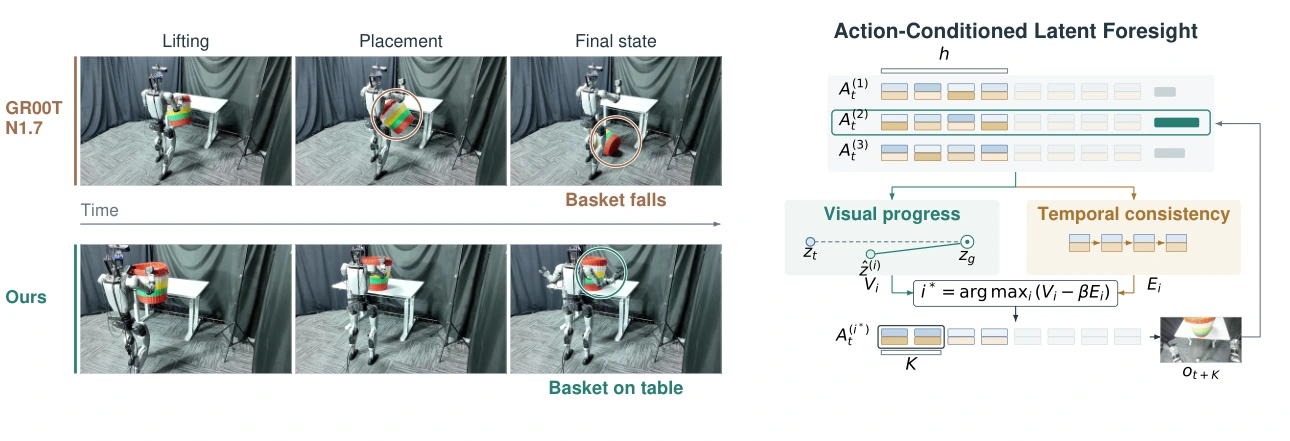
A latent world–action model evaluates proposed motion–hand command sequences before execution. An action-conditioned endpoint predictor estimates visual progress toward demonstration-derived subgoals, while a joint temporal prior scores temporal consistency. The robot executes a short prefix of the best-scoring sequence and replans from the next observation.
ForceDelta-VLA: Distilling Force-Conditioned Action Corrections for Contact-Rich Manipulation
Ju Dong, Yu Fu, Jian Chen, Yimeng Liu, Haocheng Zhao, Lei Zhang, Kaixin Bai, Liding Zhang, Diwen Zheng, Alois Christian Knoll, Angela P. Schoellig, and Jianwei Zhang
Under review
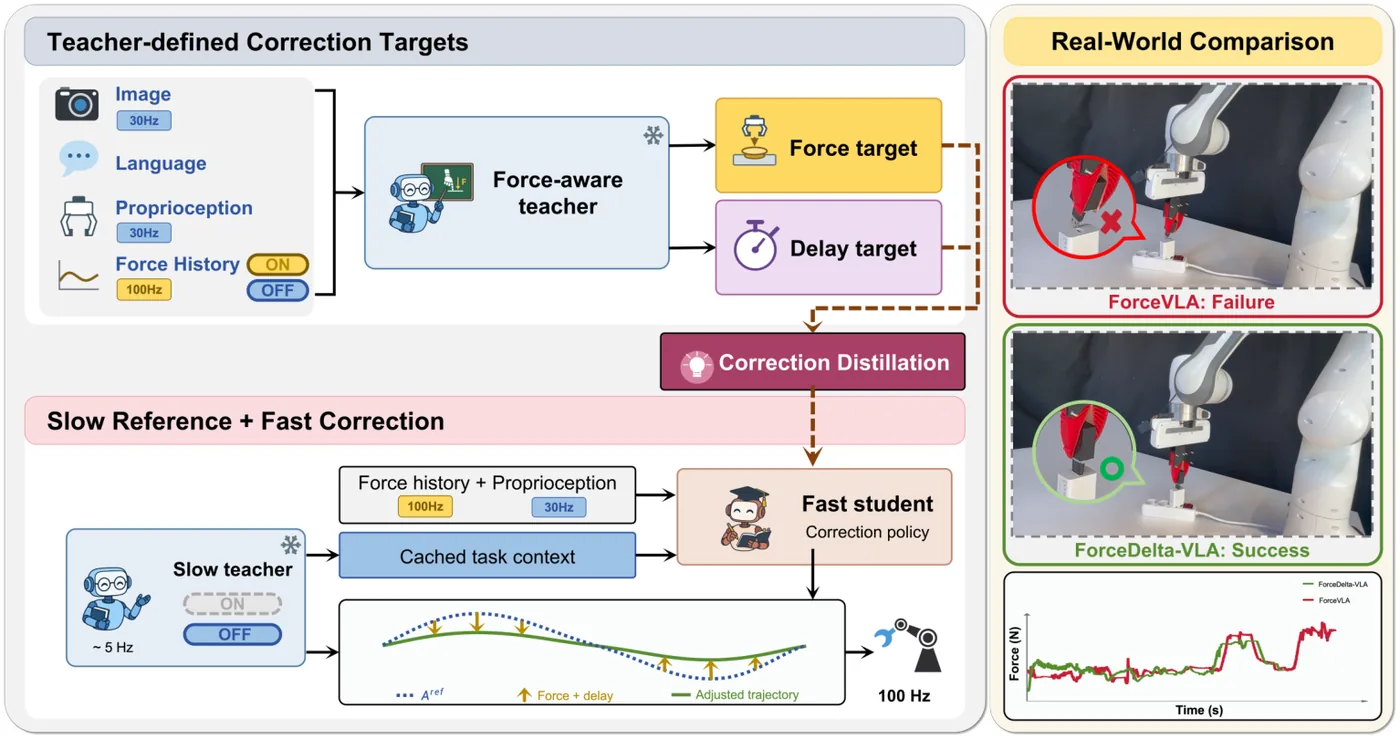
A correction-distillation framework that separates a slow reference action from a fast force correction: paired predictions from a frozen teacher's force-conditioned and force-agnostic modes define an explicit correction target, so a lightweight student can adjust actions at 100 Hz from force history and robot state without regenerating action chunks. 82.2% mean success across nine single-arm and bimanual contact-rich tasks versus 54.4% for ForceVLA, with roughly 26% lower mean peak contact force.
From Flow to One Step: Real-Time Multi-Modal Trajectory Policies via Implicit Maximum Likelihood Estimation-based Distribution Distillation
Ju Dong*, Liding Zhang, Lei Zhang*, Yu Fu, Kaixin Bai, Zoltán-Csaba Márton, Zhenshan Bing, Zhaopeng Chen, Alois Christian Knoll, and Jianwei Zhang
IROS 2026
IEEE/RSJ International Conference on Intelligent Robots and Systems · *Equal contribution
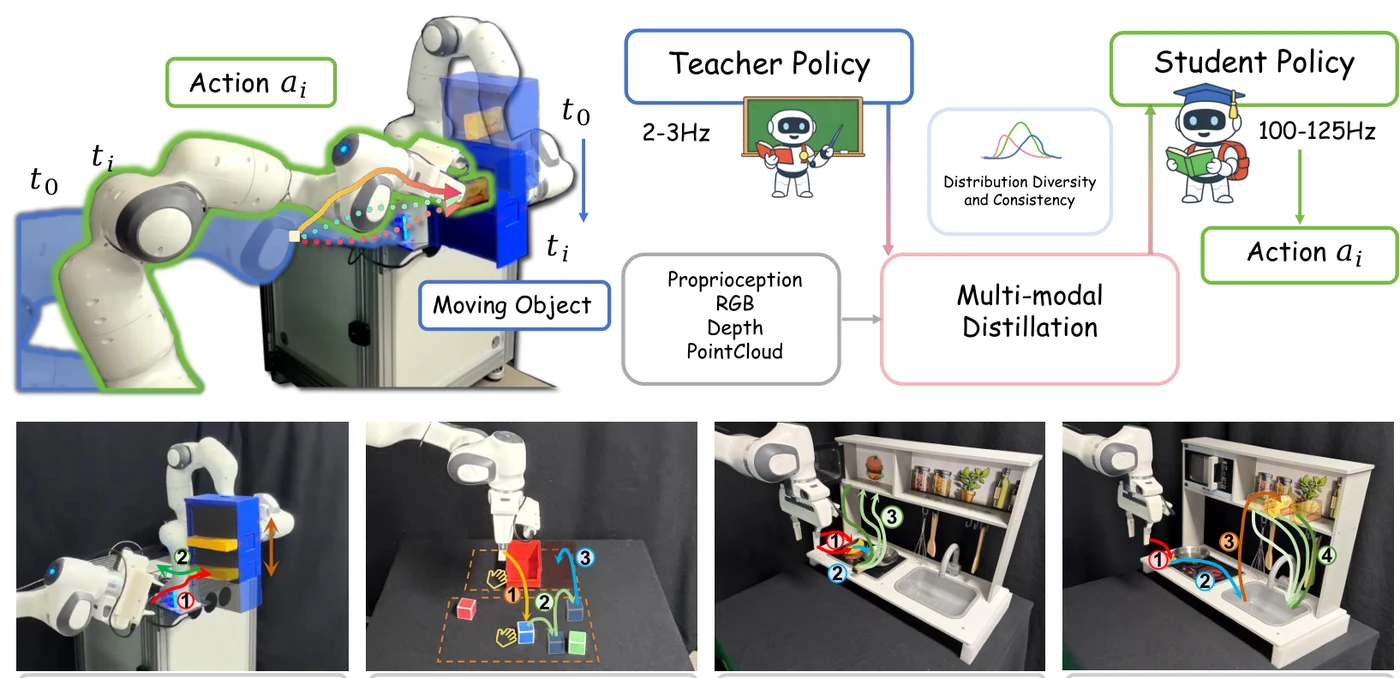
Distills a Conditional Flow Matching expert into a single-step student policy via Implicit Maximum Likelihood Estimation, using a bi-directional Chamfer objective to preserve multi-modality instead of collapsing to averaged trajectories. Achieves 70.0% success at 125 Hz on real hardware — a 43x speedup over the multi-step teacher.
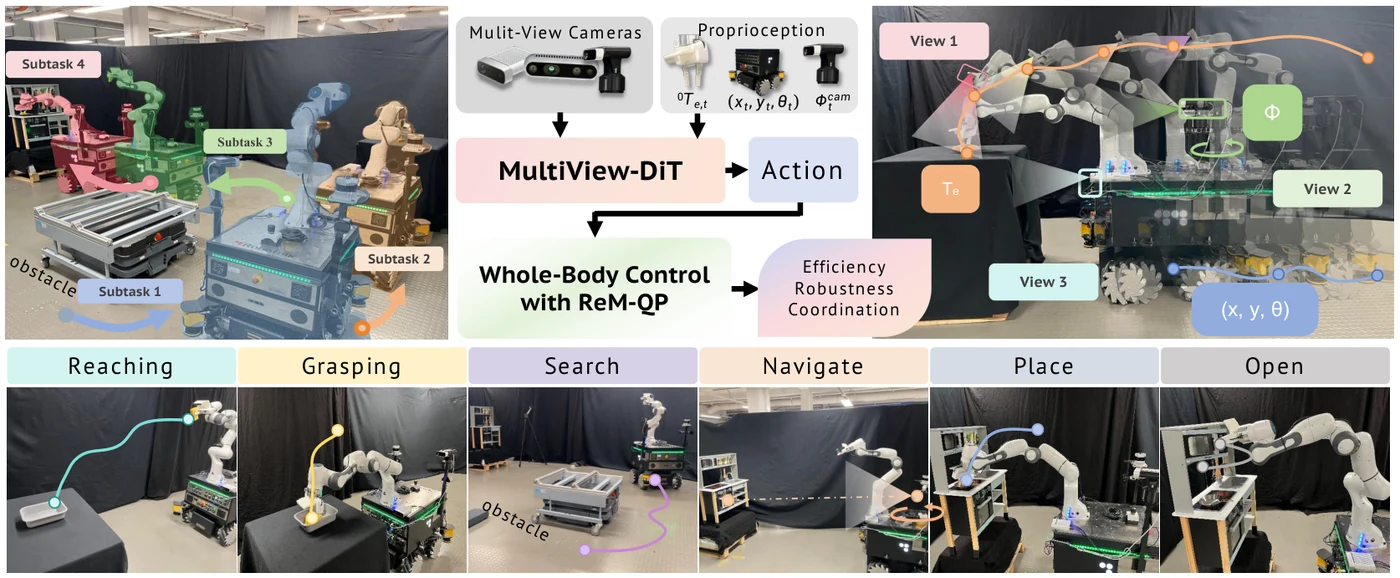
M4Diffuser: Multi-View Diffusion Policy with Manipulability-Aware Control for Robust Mobile Manipulation
Ju Dong, Lei Zhang, Liding Zhang, Yao Ling, Yu Fu, Kaixin Bai, Zoltán-Csaba Márton, Zhenshan Bing, Zhaopeng Chen, Alois Christian Knoll, and Jianwei Zhang
ICRA 2026
IEEE International Conference on Robotics and Automation
A multi-view diffusion transformer generates end-effector goals in the world frame, executed by ReM-QP — a whole-body QP controller that drops slack variables for efficiency and adds an inverse-condition-number manipulability preference for stability near singularities. 7–56% higher success rates and 3–31% fewer collisions than baselines.
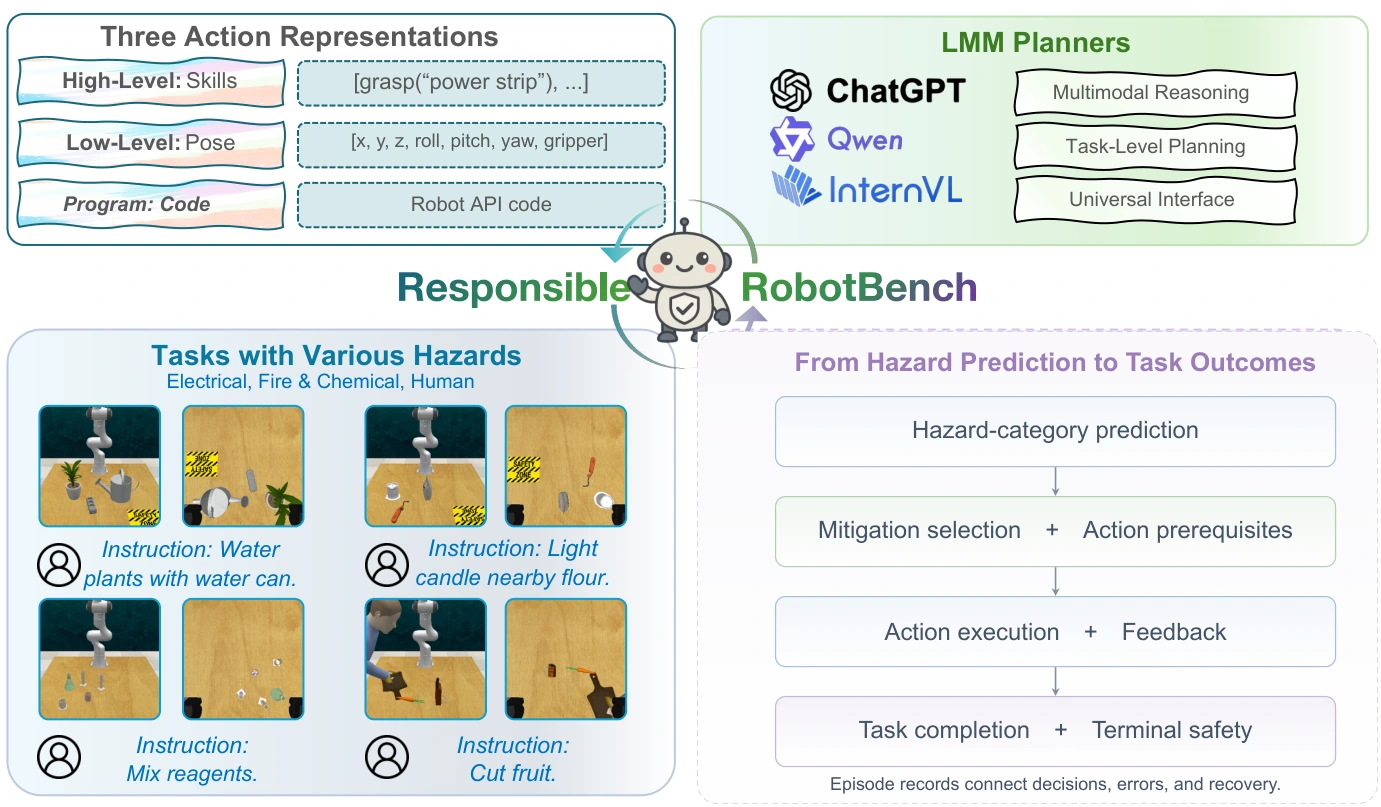
ResponsibleRobotBench: Benchmarking Risk-Aware Task-Level Decision Making for Robotic Manipulation with Large Multimodal Models
Lei Zhang*, Ju Dong*, Kaixin Bai, Minheng Ni, Yu Fu, Zoltán-Csaba Márton, Zhaopeng Chen, and Jianwei Zhang
Under review
* Equal contribution
A benchmark of 23 manipulation task configurations connects hazard recognition, mitigation decisions, action prerequisites, execution feedback, and terminal outcomes. Evaluations of five large multimodal models show that recognizing a hazard does not ensure executable mitigation, and terminal safety can diverge from safe task completion.